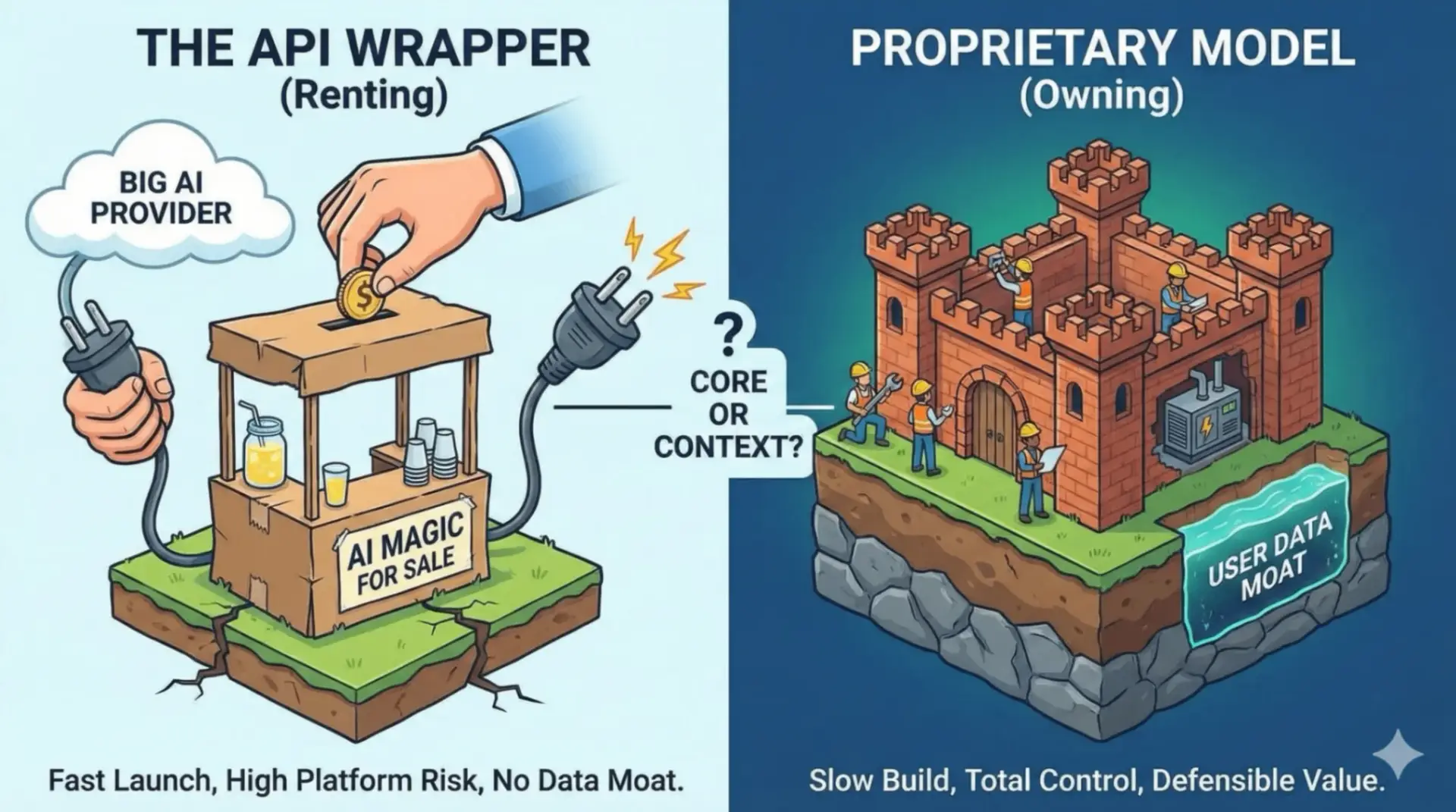
The Illusion of Speed
The allure of the “Buy” option (using foundational model APIs like GPT-4, Claude, or Gemini) is intoxicating. As a Product Manager, you can prototype a magical feature in a weekend. You can launch in a month. You don’t need an army of data scientists. The TTV (Time to Value) is incredible.
It feels like a no-brainer. Why do the heavy lifting when Sam Altman has already done it for you?
The “Landlord Problem”
When you build your product entirely on top of a closed-source API, you are a tenant. The landlord controls the building.
-
Margin Compression: When you scale, your API costs scale linearly. There are no economies of scale. The model provider keeps the lion’s share of the margin.
-
Platform Risk: Remember when Twitter killed 3rd-party clients overnight by changing its API? That can happen to your AI wrapper. If OpenAI releases a feature that does what you do, you’re dead.
-
No Data Moat: You are sending your precious user data to train someone else’s model. You aren’t getting smarter; they are.
The Case for “Build” (Owning the Intelligence)
“Building” in 2025 doesn’t necessarily mean training a massive LLM from scratch. It usually means taking an open-source model (like Llama 3 or Mistral) and fine-tuning it on your proprietary data.
This path is harder. It requires more upfront capital, talent, and infrastructure. But the rewards are strategic:
-
Control & Privacy: Your data never leaves your VPC (Virtual Private Cloud). Crucial for enterprise and healthcare clients.
-
Cost at Scale: Once trained, running your own specialized model is vastly cheaper than millions of generic API calls.
-
A Real Moat: Your fine-tuned model, trained on your unique dataset, is something competitors cannot just clone by getting an API key.
The Framework: Core vs. Context
How do you decide? I use the “Core vs. Context” framework, updated for AI.
-
Context (Utility): Is this feature just a necessary utility that doesn’t differentiate you?
-
Examples: Summarizing emails, basic chatbots, generic text generation.
-
Strategy: Buy (Rent the API). Don’t waste resources building what is already a commodity.
-
-
Core (Secret Sauce): Is this feature your primary value proposition? Is it the reason customers choose you over others?
-
Examples: A legal AI trained on 50 years of specific case law; a biotech AI designed for drug discovery.
-
Strategy: Build (Own the Model). Your core competency must be owned, not rented.
-
Conclusion
The “sugar high” of launching an API wrapper is fun. But great companies are built on defensible value.
As a PM, don’t just optimize for the next launch date. Optimize for long-term survival. Don’t let short-term convenience mortgage your company’s future.